
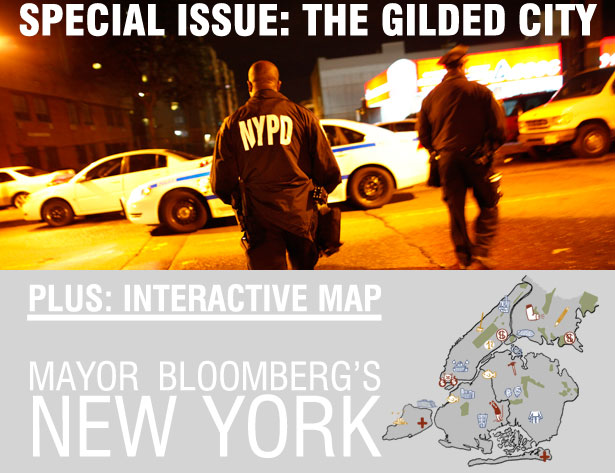
After nearly twelve years in office, Mayor Michael Bloomberg has proved himself a powerful force, and has become at once a symbol and a source of many of the city’s changes. From his perch at City Hall, and with the aid of both imperial wealth and an often imperious personality, he has pushed a vision of the city that has charmed the chattering classes and confounded critics, even as it has defied easy categorization.
Amid the two-tier urbanism of the Bloomberg era, many people have been working hard to make the city a more equal place. Workers have been coming together at fast-food restaurants, retail stores and car washes. Liberal-minded politicians, calling themselves the Progressive Caucus, have brought innovative ideas to the City Council. A coalition of the stopped-and-frisked has pressed for big changes in policing policy.
New York is a city forever giving birth to itself. It is no accident that Occupy Wall Street was born here. And in November, when New Yorkers go to the polls to elect a new mayor for the first time in twelve years, the city will reinvent itself yet again. “People aren’t good at describing what is in their own interest,” Bloomberg has said, to explain why he described it for them. Now the people will have a chance to define for themselves what kind of New York they want to live in: a Gilded City, or a genuinely democratic one.
Inside The Nation‘s special New York issue:
Welcome to the Gilded City of New York
by The Editors
What Happened to Working-Class New York?
by Joshua Freeman
A Wall Street State of Mind
by Steve Fraser
The Legacy of the 1970s Fiscal Crisis
by Kim Phillips-Fein
How the One Percent Rules
by Doug Henwood
Wanted: A Progressive Mayor
by Jarrett Murphy
The Once and Future Harlem
by Sharifa Rhodes-Pitts
Resurrecting Brownsville
by Ginia Bellafante
The Education of Michael Bloomberg
by Leonie Haimson and Diane Ravitch
Noose York
a poem by Lemon Andersen
‘Koch,’ ‘The Central Park Five,’ and the End of Doubt
by Gene Seymour
A Bold Progressive Vision for the New York City Council (Really!)
by Brad Lander
Why New York Is Still the Capital of Immigrant America
by Ghita Schwarz
The Car-Chasers of Hunts Point
by Charles Rice-Gonzalez
The Borough That New York Forgot
by Alex Gilvarry
Life in the Cellar
by Suketu Mehta
Low-Wage Workers Unite
by Lizzy Ratner
Bloomberg by the Numbers
compiled by Alleen Brown
Interactive Map: Bloomberg’s New York
graphics by Susie Cagle
Video: Planning New York
featuring Doug Henwood
Video: Brownsville, the Gentrification Exception
featuring Ginia Bellafante
Sugar Rush and Stomachache: On ‘NYC 1993’
by Barry Schwabsky
Dreams Built and Broken: On Ada Louise Huxtable
by Alexandra Lange
The Sons of Revolution and Steerage: On ‘City of Ambition’
by Richard Kreitner

